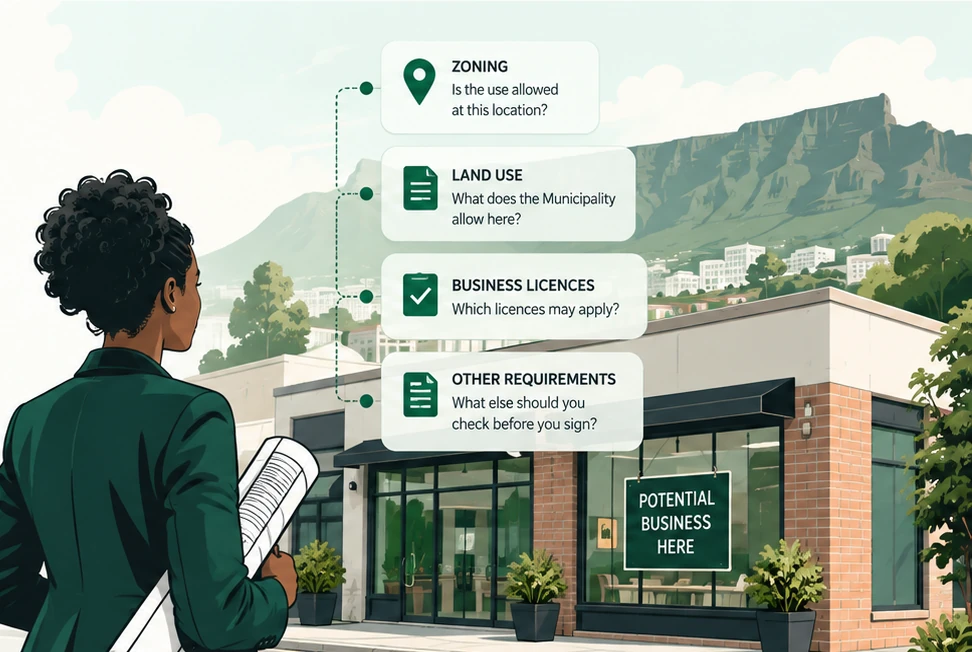
Before you sign a lease, pay a deposit or start fitting out a commercial space, check whether the premises fit the business you actually intend to run there.
Mzansi SiteCheck helps Cape Town business owners, tenants and operators bring the important public premises evidence into one decision: the exact property, its zoning and land-use position, the intended business, relevant licence or food-premises requirements, fire and fit-out questions, and the facts that still need to be verified. Official source
It is not a legal clearance certificate and it does not pretend that one zoning label answers everything.
A commercial address is not a compliance answer
A shopfront can look perfect. A landlord can say the premises have always been commercial. A lease can even describe the intended use. None of those facts, on their own, proves that the exact operation you want to run is ready to open.
The City of Cape Town says every property has a zoning category that determines what it can be used for, and specifically tells businesses such as restaurants and industrial workshops to check zoning before opening. For businesses that fall within licensing categories, the City's process can also depend on premises-level items including land-use clearance, fire clearance, a Certificate of Acceptability and an approved interior building plan.
That is why Mzansi SiteCheck treats premises readiness as a joined decision rather than a zoning lookup.
The four layers we bring together
First, confirm the exact City property or parcel being assessed. A listing pin or map coordinate can help with orientation, but it is not treated as proof of parcel identity. Once the property is established, the premises decision is separated into four layers.
1. Land-use rights
Establish what the public zoning and land-use evidence says about the business you intend to operate. A base-zoning result is useful evidence, but it is never treated as full premises clearance. See the Cape Town business-use zoning guide for the distinction between a commercial listing and permitted uses.
2. Premises and building evidence
Identify what is known about approved plans, occupancy or use evidence, the existing premises and proposed alterations or fit-out. Missing or conflicting building evidence stays visible instead of being assumed away.
3. Business-operation requirements
Check which licence, food-premises, fire, health or other operation-specific requirements may apply to the business you actually intend to run from the premises.
4. Transaction blockers before commitment
Show what still needs to be resolved before a lease, deposit, design or fit-out commitment. If important evidence is unavailable or unclear, Mzansi SiteCheck keeps it as a verification item and shows what needs to be established rather than turning the unknown into a green light.
Start with the business you intend to run
Restaurant or café
A restaurant decision can involve zoning/use rights, a business-licence route, food-premises requirements, fire safety, approved plans and the intended fit-out. Start with: Can I open a restaurant at these premises?
Retail or shop
A general commercial label does not automatically establish that every specific retail operation is permitted or opening-ready. The exact use and premises facts matter.
Office
Office use may be simpler than a food or entertainment operation, but the exact property and any alterations or private restrictions still need to be separated from assumptions.
Workshop or service trade
The operational nature of the activity matters. Noise, equipment, building use and the applicable zoning/use route can make a seemingly suitable unit a very different premises decision.
Compare the premises questions for a shop, office or workshop before treating the listing category as permission.
Food-premises guides
If the intended operation involves food or beverages, use the premises guides to separate the business type from the approvals and premises evidence around it.
- Restaurant premises
- Café and bakery premises
- Certificate of Acceptability
- Building plans and fit-out
- Fire clearance
Before money moves
The useful time to find a premises problem is before it becomes sunk cost.
Use the public evidence as an early decision layer before, where possible:
- paying a non-refundable deposit;
- signing a long lease;
- committing to architects, designers or contractors;
- ordering equipment that depends on the premises;
- starting structural or significant fit-out work.
A premises check does not replace legal review of a lease or advice from the relevant authority or professional. It helps you know which questions need answers before commitment.
Evidence first. Unknowns stay explicit — with a next step.
Mzansi SiteCheck prioritises City of Cape Town and other primary public sources. Each decision separates what the evidence supports from what it does not prove. If an important fact cannot be established, the gap stays visible and the next verification step should be clear: what needs to be established, what evidence may resolve it, who may need to confirm it, and whether it should be resolved before commitment. Missing evidence is never turned into a green light.
Check a premises
See the evidence to gather for a specific commercial address before money moves.